When I first told friends about my Arcades Project, I would often get the question: “What is an arcade?” or “How do you define the word ‘arcade’?”.
The 19th century arcades were a revelation, allowing shopping away from the elements, be they rain and wind or the sun and dust in places like Australia. They were also often a place simply to be seen, the ‘promenaders’ or ‘flaneurs’ in Paris, though many of the arcades reviewed here were workaday shopping streets.
In one sense, the modern shopping mall, whether in the city centre or on the outskirts of urban developments, is the contemporary version of an arcade. It just lacks the charm of a real vintage arcade.
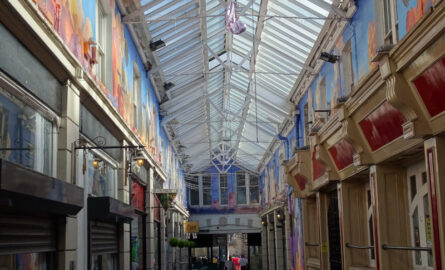
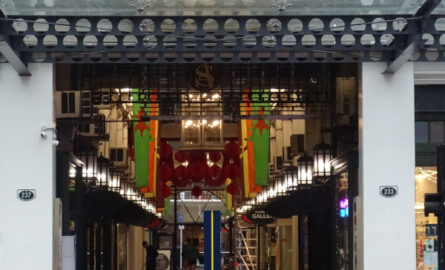
What defined the 19th century arcade was the use of ironwork and glass, usually in the ceilings or roofs, so many of the arcades still in existence today have retained some form of glass roof with iron frames, and ironwork gateways at their entrance.
So what isn’t an arcade?
A covered market, an indoor market, tends to be a large open-plan space with separate stalls, but this is not a passageway, which is probably where the ‘arcade’ meaning comes in. In French, the translation for ‘arcade’ is either ‘passage,’ or walkway connecting two points or streets, or ‘galerie’ which is a rather more grand term, and can also be used for a single block, as in ‘Galeries Lafayette’ department store in Paris.
Some ‘passages’ in France connect two points but are not covered, have no ceiling or roof, and so these do not make it into my definition of arcade.
Some ‘arcades’ in Mediterranean countries are simply covered street shopping, the ‘arcades’ being stone arches opening onto the streets, so shoppers have air flow but no blast of heat from direct sunlight. These, too, do not qualify as ‘arcades’ in my Arcades Project, probably because they are not enclosed.
When did arcades stop being built, and when were they replaced by malls? Margaret MacKeith’s gazetteer of extant British arcades defines arcades as having been built between 1817 and 1939, the latter still under the Art Deco influence. But then came the Second World War, when so many of Europe’s old arcades must have fallen victim to bombings, and after the War things took time to rebuild. By the 1950s, the American-style shopping mall began to replace vintage arcades, with the drift to out-of-town malls following close behind.